
Ángela Figuera: Know about the life and work of one of the most important Basque poets
- Web News
- Jan 2, 2023
- 4 min read

Updated: Jan 12, 2023

Ángela Figuera Aymerich
Belonging to the group of post-war poets, the so-called generation of '36, very marked by the Civil War and the subsequent World War, Ángela Figuera was a Basque poet that wrote about social themes and equality. Know more about her life and work in this article.
Image from the website Regloneszurdos
Some important milestones
Ángela Figuera Aymerich was born in Bilbao on the 30th of October of 1902.
In her early years, since her mother was sick, she had to take care of her brothers and spent lor of time with them, so she started to write children’s stories and poems. Her first poems were written in the 20s and appear in a Cuaderno Inedito kept by her family.
She studied at the Sacre Coeur french catholic college in the Bilbao Provincial Institute and completed her bachelor's in 1924.
Afterward, in 1925, she initiated her studies in Philosophy. Due to the death of her father in 1926, the economic problems in her family led her to work in a steel factory. At the same time, she starts a relationship with her cousin Jose Figuera. In 1930 she moves to Madrid and started working in colleges. Three years later, she went to Huelva to work as a High School Teacher. She and her cousin started living in this new city and got married in 1934.
However, in 1936, she had to confirm her appointment as a professor by taking some courses and the couple returned to Madrid, unaware that Franco's uprising in Morocco was already being prepared. At the start of the civil war, Àngela's husband, of socialist ideology, enlisted in the army. It is in Madrid that his son, Juan Ramón, is born on December 30, 1936, when bombs rain down on the city. In February 1937, Ángela and her family moved to Valencia, and there she was assigned to the Alcoy Institute.
In 1938, Ángela requested a transfer to Murcia to be close to her husband, who had been assigned to the city of Molina de Segura.
Important books
Ángela dedicates her time to her son and to writing in the first years after the war.
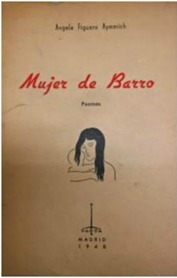
The war inspired her to her first book, published in 1948 called Mujer de Barro which is based on her sense of being a mother and a woman during a complicated environment.
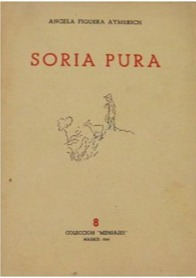
A year later she published Soria Pura- a tribute to the “melancholic Castilian city” where she spent some time. The influence of Antonio Machado in her writing is perceived. This last book received the literature prize Verbo. After this book, she starts a literary relationship with Blas de Otero, another basque poet.
In 1950, Ángela writes Vencida por el ángel one of the most important examples of the post-war spanish literature. In this poems, Angela showed the extreme poverty of Spain, the pain of losing the war and the degradation of poor and exploited women.
The book El Grito Inutil was released two years later. In this new work she consolidates her way of writing: free verse where it prevails the anaphora, metonymy and apostrophe.



Writing during a troubled life
Ángela Figuera is known for writing about her social commitment and her criticism of Francoism, which is why the dictatorship dispossessed her of her teaching position. In a man’s world, she questions on her poetic work the model that culture imposes on women.
Ángela Figuera had problems with the censorship because of Mujer de Barrio and Soria Pura once, even though they’re message wasn’t against the regime, it had a sensual and erotic character.
Ángela continued her work and in 1953 she released Los días duros and Víspera de la vida, in 1953, in which she reclaims the full meaning of life.
At that time, in order to avoid the censorship warnings, she decides to return to a bigger city that she already had lived in, Madrid. There, in 1952 she started to work in the National Library and being a translator. Two years later, she also started to incorporate the service of a bookmobile “bibliobuses”, a system of reading popularization. In 1969 she travelled to Mexico to escape from the war.
The Legacy of Ángela Figuera Amerych
Her writing is considered honest and humanitarian and gave voice to the gender equality issue. Her words sounded like feminine sentimentalism and pioneers in the spanish feminism. The style is realistic and naturalist with a mixed of progressive ideas that give the work a revolutionary and modern character. She passed away with a disease, in Madrid in the 2nd of April of 1984.
Nowadays, Ángela Figuera is still remembered by Bilbao´s population. Annually, there are always some events that tribute her life and work, such as this year´s tribute on the 28th of october by the musicians Lorena Paz Nieto y Alberto Nieto at Biblioteca Municipal Bidebarrieta, that our team covered.









Photos by Baskulture team, taken at the Musical Tribute to Angela Figuera Amerych by Lorena Paz Nieto and Alberto Nieto in the Biblioteca Municipal Bidebarrieta, Bilbao. (28/10/2022)
Sources: Bilbaopedia , Biografías y Vidas

Comments